
For the past couple of years, “AI” has mostly meant chatbots—tools that answer your questions, write emails, or help you brainstorm. But in 2026, the conversation has fundamentally shifted. We have entered the era of Agentic AI.
If you think of Generative AI as a “smart assistant” that drafts text, Agentic AI is the “digital employee” that actually gets the job done.
What is Agentic AI?
Unlike traditional AI that waits for your prompt, Agentic AI systems are designed to be autonomous. They are goal-oriented. You don’t tell an agent how to do a task; you tell it what the desired outcome is, and the agent figures out the steps, navigates software, interacts with APIs, and executes the work.
Read More : Tech Job Market Freshers March 2026: Why Candidates Are Struggling
The Key Difference:
- Chatbots (Reactive): You ask, “Can you draft a report?” It gives you the text. You then have to copy, paste, format, and email it yourself.
- Agentic AI (Proactive): You say, “Create and email the monthly sales report.” The agent fetches the data, structures the report, formats it, and hits ‘send’.
Why Agentic AI Matters in 2026
Businesses are no longer looking for “efficiency” in the traditional sense; they are looking for endurance. With Agentic AI, companies are building “orchestrated workforces” where specialized agents collaborate to handle complex workflows without constant human oversight.
Where It’s Transforming Business:
- IT & Operations: Autonomous agents are now auto-resolving service tickets and managing cloud costs in real-time.
- Sales & Marketing: Instead of just generating ad copy, agents now manage entire campaigns, testing and optimizing them based on live conversion data.
- Finance: Agents are reconciling ledgers, detecting fraud, and forecasting cash needs without manual intervention.
The 2026 Trend: The Multi-Agent Enterprise
The biggest trend this year is the shift from “single-agent” tasks to coordinated teams of agents. Enterprises are using orchestration platforms to manage dozens of agents that talk to each other.
“The future of AI isn’t a robot; it’s a team.”
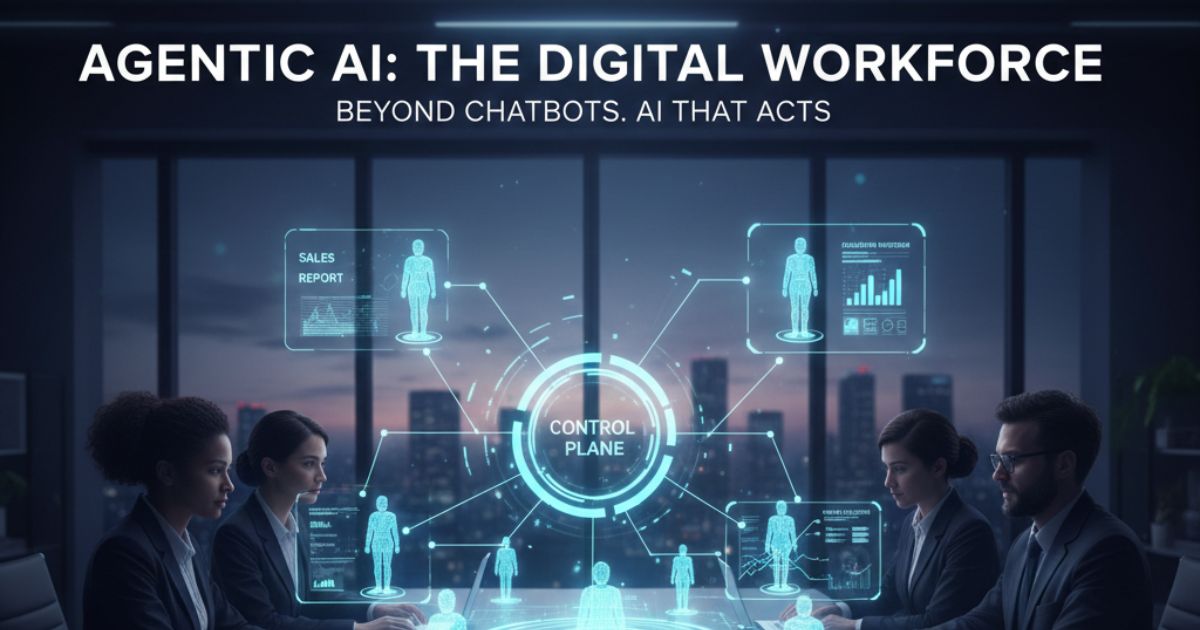
This means that complex processes—like shipping logistics or software development—are now being handled by a “control plane” of agents that can resolve conflicts and enforce policies autonomously.
Final Thought
Agentic AI marks the moment technology stops being just a “tool” and starts becoming the fabric that businesses run on. We are moving away from asking AI for help and toward building systems that proactively solve problems before we even notice they exist. The companies that learn to “manage” these digital workforces in 2026 will be the ones that outpace the market.
FAQs
Q1: Is Agentic AI the same as AGI?
No. While Agentic AI shows intent and autonomy, it is still goal-specific. It is a major step toward AGI, but it operates within defined operational boundaries and roles.
Q2: Do I need to be a programmer to use these agents?
While developers have the most control, 2026 has brought “Agentic Frameworks” that allow non-technical business users to build and deploy agents using natural language.
Q3: Is it safe? What about security?
Governance is the biggest hurdle. In 2026, “Validation-as-a-Service” and strict human-in-the-loop guardrails are non-negotiable for any enterprise deploying autonomous agents.
Q4: Will Agentic AI replace human employees?
Rather than full replacement, roles are shifting toward “oversight.” Humans are moving from being “doers” to “architects” who manage and monitor agent workflows.
Q5: How does this affect small businesses?
Small businesses can now scale output without needing to grow their headcount. An agent can act as a 24/7 sales, support, or marketing team for a fraction of the cost.
Read More : OpenAI GPT-5.4 Review: Can It Really Operate Your Computer Without You?