
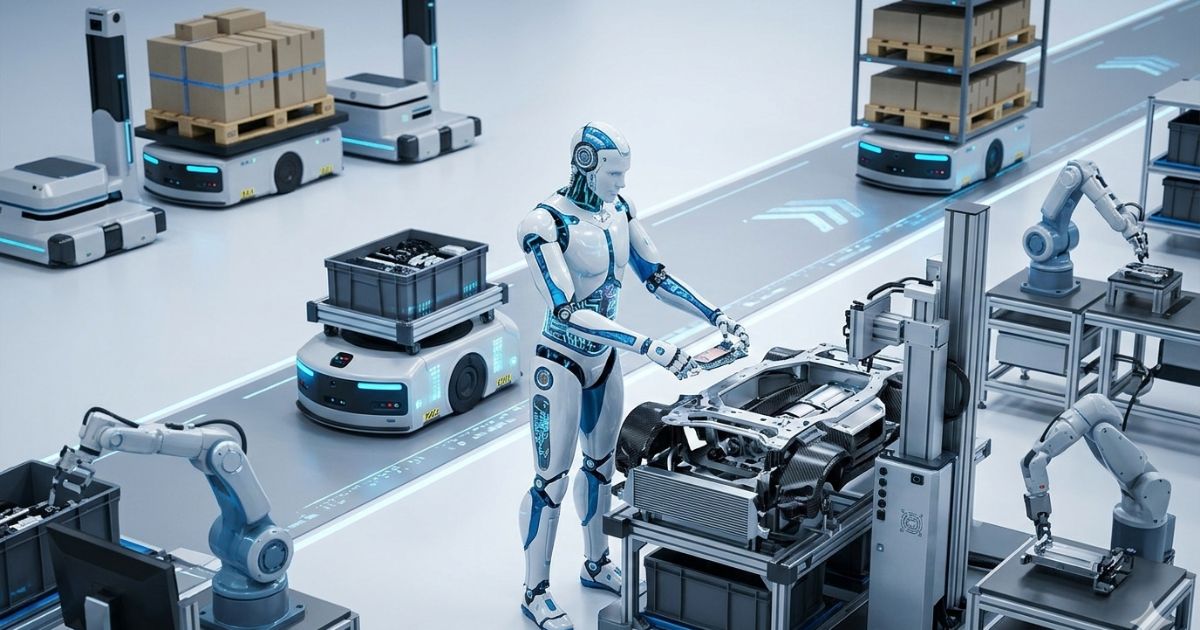
For years, AI was trapped behind screens—answering emails, generating images, or writing code. But in 2026, we are witnessing the “Great Embodiment.” AI has officially moved from digital chatboxes into physical bodies. This is Physical AI, and it’s changing the world far beyond the walls of a computer lab.
Whether it’s a humanoid robot picking parts in a factory or a warehouse system that “feels” its way through a cluttered floor, AI is finally mastering the laws of physics.
The Powerhouses: How Amazon and BMW are Leading
Two of the world’s biggest names are already showing us what a Physical AI-driven future looks like.
1. Amazon’s “Sequoia” and the Million-Robot Fleet
Amazon recently hit a massive milestone by deploying its one-millionth robot. But it’s not just about the numbers; it’s about the intelligence.
- Sequoia & Proteus: These aren’t just machines following a line on the floor. Using the DeepFleet AI model, these robots now navigate around humans and obstacles in real-time, using sight and touch.
- The Result: Amazon has reported a 75% increase in warehouse efficiency, reducing the time it takes to process an order from days to just a few hours.
Read More : Beyond Chatbots: Why Agentic AI is the Real Game-Changer in 2026
2. BMW’s “Self-Driving” Factory
At BMW’s plants, the cars themselves have become the robots.
- Autonomous In-Plant Logistics: Newly built BMWs now use AI and digital mapping to drive themselves off the assembly line, through testing stations, and straight to the shipping area—no human driver required.
- Humanoid Pilots: BMW is also trialing Figure 02 humanoid robots in South Carolina. These robots handle ergonomically difficult tasks, like sheet metal assembly, working alongside humans without needing safety cages.
Why 2026 is the Turning Point
Physical AI is different from the “old” robotics because of three major breakthroughs:
- World Models: Instead of being programmed for one task, robots now use “world models” to understand space, gravity, and object properties.
- Simulation-to-Reality (Sim2Real): Robots are now trained in hyper-realistic virtual factories (Digital Twins) for millions of hours before they ever touch a real floor.
- Hardware Affordability: The cost of high-performance sensors, LiDAR, and batteries has dropped, making it possible for even smaller businesses to adopt smart automation.
Final Thought
Physical AI is the moment technology stops being something we use and starts being something we work with. By mastering the physical world, AI is no longer just a digital assistant; it is becoming a partner in the real world. The “Self-Correcting Factory” is no longer science fiction—it is the standard of 2026.
Frequently Asked Questions (FAQs)
Q1: Is Physical AI the same as a regular industrial robot?
No. Traditional robots follow fixed paths (like a mechanical arm). Physical AI agents can perceive their environment, learn from mistakes, and adapt to changes—like a person would.
Q2: Will these robots replace all factory workers?
In 2026, the shift is toward “Hybrid Workforces.” Humans are moving away from repetitive, dangerous tasks and becoming “Robot Technicians” or “Orchestrators” who manage teams of AI agents.
Q3: Can Physical AI work in my home?
Yes. While the biggest moves are in factories, 2026 is seeing the rise of smart home robots that can actually fold laundry or tidy up, thanks to better “fine motor control” AI.
Q4: Is it safe for humans to work near these robots?
Absolutely. Physical AI uses advanced “Sensor Fusion” to detect human presence instantly, allowing them to slow down or change paths without the need for physical barriers.
Q5: What is the “DeepFleet” model Amazon uses?
DeepFleet is a Generative AI foundation model specifically designed for logistics. It coordinates the movements of thousands of robots simultaneously to prevent traffic jams and optimize speed.
Read More : iQOO Z11x Launch Date Confirmed: Will It Redefine Budget Battery Phones?