
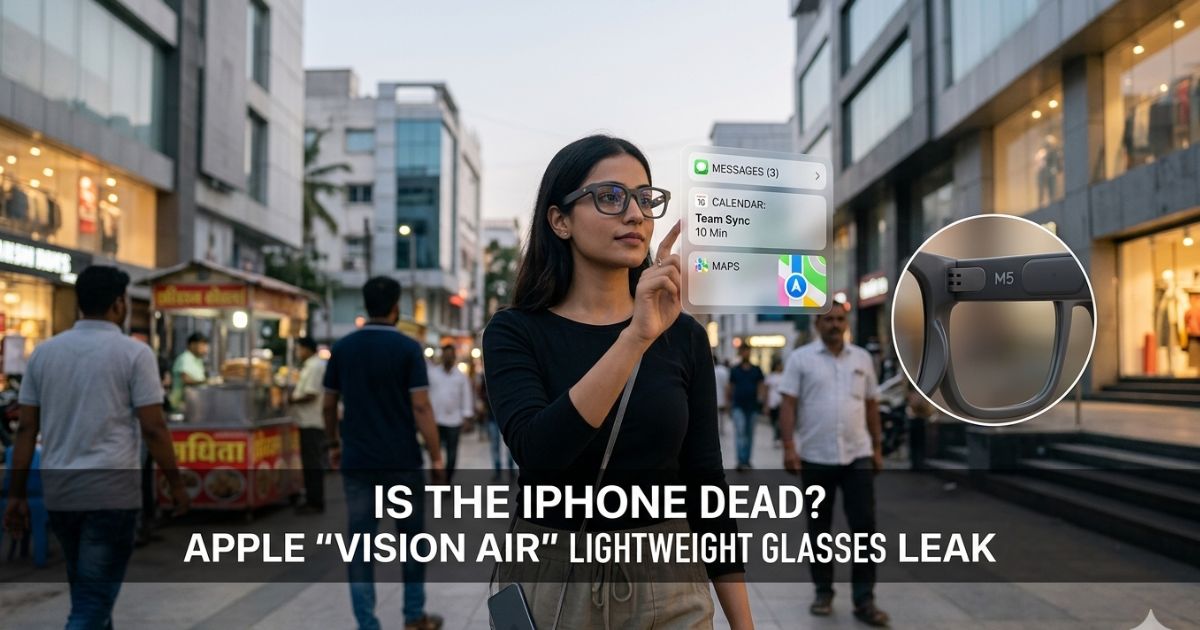
The era of the heavy, “ski-mask” spatial computer may have been short-lived. Just as competitors are closing in on the high-end Apple Vision Pro, new, definitive leaks from Apple’s supply chain in Vietnam have confirmed a radical shift in their augmented reality strategy.
Meet the Apple “Vision Air”. This new device isn’t just a cheaper Vision Pro; it’s a fundamental rethinking of spatial computing, designed to be wearable in public, all day, and possibly replace your iPhone.
1. What is the Vision Air? The Anti-Vision Pro
The core philosophy of the Vision Air is lightweight portability. According to leaked documents, Apple realized that the Vision Pro’s 600+ gram weight was the primary barrier to mainstream adoption.
Key Innovations:
- The “Glasses-First” Design: Instead of a bulky headset, the Vision Air looks remarkably like regular, stylish, thick-rimmed glasses. The front glass is significantly thinner, and the massive battery is no longer tethered to your hip.
- Silicon-on-Glass Technology: Apple has reportedly embedded the processing (a new, fanless M5-series chip optimized for efficiency) directly into the temples of the frames.
- The Weight Breakthrough: Rumors suggest the Vision Air weighs a mere 95 grams—less than one-sixth the weight of the Vision Pro.
Read More : Motorola Edge 70 Fusion Launch: 7000mAh Battery King is Here!
2. Ditching the Eyesight Feature for Privacy and Battery
To achieve this weight, Apple had to make difficult compromises. The biggest casualty is the iconic (and controversial) EyeSight feature. The Vision Air’s front glass is opaque, like standard glasses, meaning others cannot see your eyes when you use it.
Other Major Trade-Offs:
- Lower Resolution: While it won’t offer the 4K-per-eye experience of the Pro, it will use new Micro-LED displays capable of extremely sharp text for productivity.
- Simplified Interface: Instead of pure hand-and-eye tracking, the temples of the glasses feature force-touch controls for rapid interaction.
- No Local Battery: Like original rumors for the Pro, the Vision Air’s internal cell is only for a few minutes of use. It requires a permanent wireless connection to a host device—initially your iPhone, or, by 2027, possibly your Apple Watch Ultra.
3. Price and Position: A New Entry Tier
The “Vision Air” name confirms its position:
- Pro (The Creator): High-end, isolated, high-compute (like MacBook Pro).
- Air (The User): Lightweight, social, everyday, high-mobility (like MacBook Air).
- The Estimated Price: Leaks point to a base price of $799 (₹69,900), placing it directly as an alternative to the top-tier iPhone Pro models.
Final Thought
With the Vision Pro, Apple created a specialized tool. With the Vision Air, Apple is creating a new category of “Smart Wear.” The fundamental question of March 2026 isn’t just “Will you buy these glasses?” but “Do you really need an iPhone anymore if your glasses do it all?”
Frequently Asked Questions (FAQs)
Q1: When will the Vision Air be officially announced?
Given the maturity of the supply chain leaks, a launch in late 2026 (likely at the iPhone 18 event) seems highly probable, with availability by early 2027.
Q2: Can I wear them with prescription glasses?
Yes. Unlike the inserts for the Vision Pro, Apple is developing a unique mechanism where the main lens can be snapped in or custom-manufactured to your prescription at an Apple Store.
Q3: Can people see what I am looking at?
No. The displays use advanced “Light Seal” technology to ensure that the light is projected only towards your eyes, preventing light leakage in all but the brightest conditions.
Q4: How does it connect if there is no wire?
It will use a new, proprietary ultra-low-latency wireless standard, possibly “UWB-2”, allowing it to pair seamlessly with an iPhone 17 or higher.
Q5: Is this an AR or VR device?
It is a Spatial Computer optimized for AR (Augmented Reality). Its core purpose is to overlay digital information onto the real world (mixed reality) rather than completely isolate you in virtual reality (VR).
Read More : Physical AI 2026: When Intelligence Gets a Body (Amazon & BMW Leading the Way)