
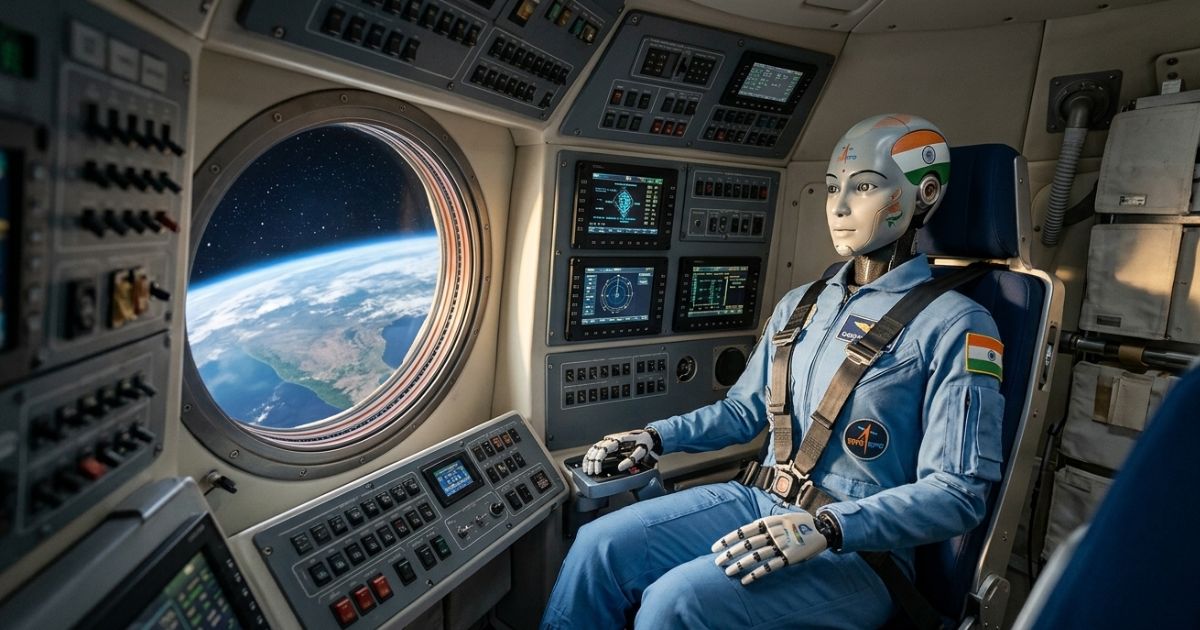
India is on the verge of making history. ISRO Chairman has confirmed that the final countdown for the Gaganyaan G1 mission—India’s first uncrewed flight test for its human spaceflight program—is set for late March 2026.
While no humans will be on board this time, the pilot’s seat won’t be empty. Instead, it will be occupied by Vyommitra, a sophisticated half-humanoid robot designed to pave the way for India’s “Gaganyatris.”
1. Meet Vyommitra: The AI “Space Friend”
The name Vyommitra comes from the Sanskrit words ‘Vyoma’ (Space) and ‘Mitra’ (Friend). Developed by ISRO’s Inertial Systems Unit in Thiruvananthapuram, she is much more than just a mannequin.
- Half-Humanoid Design: Vyommitra consists of a head, torso, and arms but no legs. This design saves weight and is optimized for the microgravity environment of a spacecraft cabin.
- Bilingual Intelligence: She can speak and understand both Hindi and English, allowing her to communicate with ground control and, in future missions, with human astronauts.
- Human-Like Actions: Vyommitra can operate switch panels, monitor cabin displays, and even respond to environment changes like air pressure drops or temperature fluctuations.
Read More : Farming in Space: ISRO Astronaut Shubhanshu Shukla Grows “Methi and Moong” on the ISS
2. The G1 Mission: A Technical Rehearsal
The G1 mission is a critical “stress test” for India’s home-grown space technology. Everything used in this mission—from the rocket to the parachutes—is “Human-Rated,” meaning it meets the extreme safety standards required to carry people.
- The Orbit: The LVM3 rocket will launch the crew module into a Low Earth Orbit (LEO) at an altitude of approximately 400 km.
- Duration: The mission will last for about 3 days, during which Vyommitra will record vital data on vibrations, acceleration, and radiation levels.
- Re-entry & Recovery: The most nail-biting part will be the re-entry into Earth’s atmosphere. The crew module will use a complex system of 10 parachutes to slow down before splashing down safely in the Indian Ocean, where the Indian Navy will be waiting for recovery.
3. Why Send a Robot First?
Space is a hostile environment. Before putting the lives of Group Captain Shubhanshu Shukla and his fellow astronauts at risk, ISRO needs to be 100% sure that the life-support systems work perfectly.
- Life Support Validation: Vyommitra will test if the cabin maintains the right oxygen levels and pressure for a human to breathe.
- Physiological Data: Sensors on the robot will simulate how a human body reacts to the “G-forces” during launch and the weightlessness of space.
- Risk Mitigation: If any system fails, it is better to have a robot on board to identify the glitch than a human.
4. Gaganyaan Timeline: The Road to 2027
| Mission Phase | Expected Date | Objective |
| G1 Mission (Uncrewed) | March 2026 | First full test with Vyommitra |
| G2 & G3 Missions | Late 2026 | Additional uncrewed validation flights |
| H1 Mission (Crewed) | 2027 | First Indian-led human spaceflight |
| Space Station | 2035 | Establishment of ‘Bharatiya Antariksha Station’ |
Final Thought
The G1 mission is not just a scientific experiment; it is a symbol of India’s growing stature in the global space community. When Vyommitra looks out of the crew module window later this month, she won’t just be representing ISRO—she’ll be representing the dreams of 1.4 billion people ready to touch the stars.
Frequently Asked Questions (FAQs)
Q1: Is Vyommitra a full robot?
She is a “half-humanoid.” Since there is no need to walk inside a cramped space capsule in zero gravity, ISRO designed her without legs to stay within the mission’s weight limits.
Q2: Will Vyommitra go to space again?
Yes, she is scheduled to fly on at least two uncrewed missions (G1 and G2) to ensure all data is consistent before the final human launch.
Q3: Can Vyommitra make decisions?
She is equipped with AI that allows her to recognize anomalies and issue warnings. However, major mission decisions are still controlled by ISRO’s mission control on Earth.
Q4: Who are the astronauts chosen for the final mission?
The four chosen “Gaganyatris” are Prashanth Balakrishnan Nair, Ajit Krishnan, Angad Pratap, and Shubhanshu Shukla. They have completed intensive training in Russia and India.
Q5: Which rocket is being used?
The LVM3 (Launch Vehicle Mark-3), formerly known as GSLV Mk III. It has been specially modified and “human-rated” for the Gaganyaan program.
Read More : Google Maps Gets Its Biggest Upgrade in a Decade: “Ask Maps” Powered by Gemini AI Rolls Out in India