
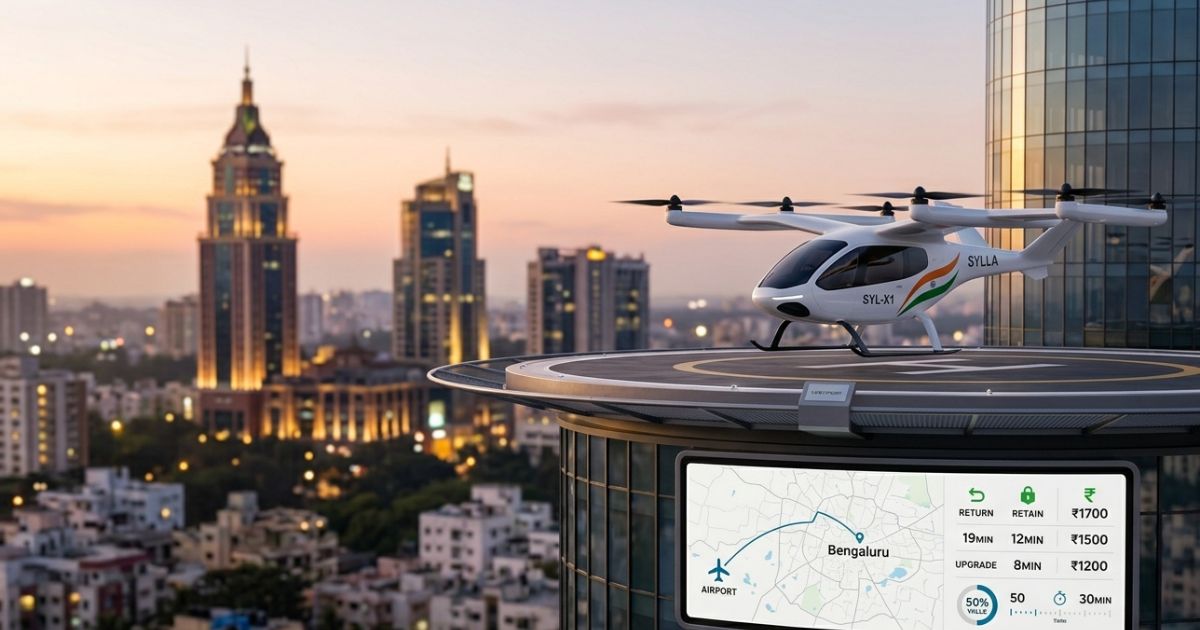
Bengaluru has just taken a massive leap toward solving its notorious traffic woes. On March 21, 2026, the city successfully hosted the official trial of India’s first domestic Electric Vertical Take-off and Landing (eVTOL) aircraft, commonly known as a “Flying Taxi.”
Conducted under the supervision of the Directorate General of Civil Aviation (DGCA), the trial marks the transition from laboratory prototypes to real-world urban air mobility (UAM).
1. The Success of “Project Shunya”
Developed by the Bengaluru-based aerospace startup Sarla Aviation, the prototype—named SYLLA SYL-X1—completed a series of critical maneuvers at a testing facility on the outskirts of the city.
- Vertical Take-off & Hover: The aircraft demonstrated a stable vertical lift-off, reaching a designated hover altitude without the need for a runway.
- Redundancy Testing: The trial proved the aircraft’s “fail-safe” design. Equipped with seven independent propellers, the SYL-X1 maintained perfect balance even when engineers simulated a motor failure.
- Noise Levels: One of the biggest wins was the acoustic profile. At cruising altitude, the eVTOL is recorded to be 100 times quieter than a traditional helicopter, making it ideal for dense residential zones like HSR Layout or Indiranagar.
Read More : Delhi EV Policy 2.0: ₹1 Lakh Subsidy, 100% Road Tax Waiver & 7,000 New Chargers
2. Slashing Commute Times: Airport to City in 15 Minutes
The primary goal for 2026 is to connect Kempegowda International Airport (KIA) with key tech hubs.
| Route | Road Travel Time (Peak) | Flying Taxi Time | Estimated Fare |
| Airport $\rightarrow$ Electronic City | 90 – 120 Minutes | 19 Minutes | ₹1,700 |
| Airport $\rightarrow$ UB City (Central) | 60 – 80 Minutes | 12 Minutes | ₹1,500 |
| Whitefield $\rightarrow$ Manyata Tech Park | 45 – 60 Minutes | 8 Minutes | ₹1,200 |
Fares are projected for the initial pilot phase starting late 2026/early 2027.
3. Technical Specifications: The “Sedan of the Skies”
The production version of the aircraft is designed to be as compact as a premium sedan, allowing it to land on existing rooftop helipads.
- Capacity: 6 Passengers + 1 Pilot (optimized for ride-sharing).
- Top Speed: 250 km/h.
- Range: 160 km on a single charge (enough for 3-4 back-to-back city trips).
- Propulsion: 100% Electric, zero carbon emissions during flight.
- Safety: Features 3-5 layers of redundancy in avionics and battery management systems.
4. Infrastructure: Vertiports and Helipads
Bengaluru is uniquely positioned for this rollout due to its existing infrastructure.
- Rooftop Access: Karnataka regulations already require buildings over 60 meters to have helipads. Sarla Aviation is working with the government to re-certify these for eVTOL use.
- Vertiports: Dedicated “Vertiports” (mini-airports for flying taxis) are planned for Electronic City, Whitefield, and Hebbal. These will feature high-speed charging docks capable of “topping up” a taxi in just 10 minutes.
Frequently Asked Questions (FAQs)
Q1: Is it safe to fly in a drone-like taxi?
Yes. These aircraft are designed with “distributed electric propulsion,” meaning they have multiple motors. Even if 1 or 2 motors fail, the remaining ones provide enough lift for a controlled emergency landing.
Q2: Will it be available for the general public immediately?
The first phase (late 2026) will focus on Air Ambulance services and premium airport transfers. General public ride-sharing is expected to scale up by 2028 as more vertiports become operational.
Q3: How do I book a flight?
Similar to Uber or Ola, you will be able to book a seat via a mobile app. You would walk to the nearest Vertiport, clear a quick security check, and board your flight.
Q4: Can it fly in the rain?
The SYL-X1 is tested for all-weather operations, though extreme weather like heavy monsoons or high-velocity winds might cause temporary groundings, just like commercial flights.
Read More : India’s “Space Junk” Status: ISRO Ranks 12th Globally in Debris, Targets Debris-Free Space by 2030