
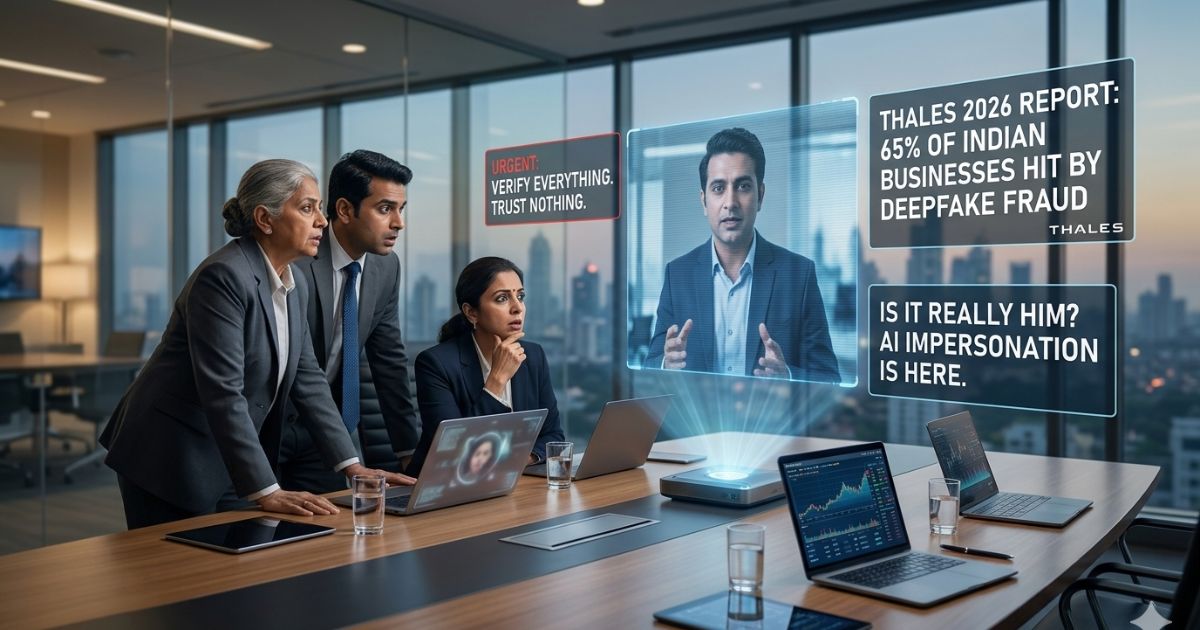
The rise of artificial intelligence has brought unprecedented innovation, but it has also handed cybercriminals a devastating new weapon. In 2026, the digital landscape for Indian enterprises is looking increasingly perilous. According to the recently released Thales 2026 Data Threat Report, a staggering 65% of Indian businesses have already fallen victim to deepfake-powered fraud.
This isn’t just about making funny videos of celebrities anymore; it’s a sophisticated attack vector targeting the heart of corporate trust and security.
What is Deepfake Fraud? (The 2026 Reality)
For the uninitiated, deepfakes use Generative AI to create hyper-realistic, fabricated videos and audio recordings that are indistinguishable from real media. In a corporate context, this is the ultimate weapon of deception.
- Identity Hijacking: Attackers don’t just steal passwords; they steal identities. By spoofing the voice or face of a CEO or CFO during a live video conference, scammers can deceive employees into authorizing illegal fund transfers.
- CEO Fraud (BEC): This traditional scam has received a high-tech upgrade. Scammers use a deepfake audio recording of a top executive to demand urgent payments, bypassing standard verification protocols.
- Sophisticated Phishing: Deepfakes make phishing attacks exponentially more believable, as a trusted executive appears to make a genuine request.
Read More : Physical AI 2026: When Intelligence Gets a Body (Amazon & BMW Leading the Way)
Thales Report: Key Findings for India
The Thales report highlights a dangerous trend for the Indian economy, which is one of the most digitalized and connected in the world.
- The Primary Target: Indian businesses, with their rapid adoption of cloud and hybrid work environments, have become a focal point for deepfake attacks.
- Beyond Financial Loss: While the immediate impact is financial, the long-term damage involves the complete erosion of internal and external trust.
- The ‘Trust Default’ Dilemma: We are fast approaching a scenario where we can no longer trust what we see and hear online, especially in professional communications.
Why 2026 is the Turning Point
The problem has escalated dramatically in 2026 due to several technological leaps:
- The Maturity of Real-Time Deepfakes: In 2024, creating a convincing real-time deepfake required massive computing power. In 2026, sophisticated software can accomplish this on consumer-grade hardware with negligible latency.
- Accessible AI Tools: The proliferation of easy-to-use GenAI tools means that sophisticated cybercriminals can now launch these attacks with minimal technical expertise.
- Human Vulnerability: Our brains are wired to believe our senses. Overcoming the initial bias that a face and voice are genuine is the hardest part of cyber-hygiene.
Final Thought
The 2026 Thales report is not a forecast; it’s a diagnosis of our current digital reality. We can no longer rely on simple visual and auditory cues for authentication. To navigate this new era of AI-powered deception, businesses must cultivate a “Never Trust, Always Verify” mindset at all organizational levels.
Frequently Asked Questions (FAQs)
Q1: What are the primary industries targeted?
Financial services, technology providers, and high-value manufacturing are the primary targets, but any organization that relies on digital communications is at risk.
Q2: How can I detect a deepfake in real-time?
While becoming nearly impossible, some tells include unnatural blinking patterns, subtle mismatches in audio sync, artificial skin textures, and glitches around the mouth or eyes, especially during rapid movement. However, the most reliable defense is to verify through a secondary, trusted channel (e.g., an out-of-band call).
Q3: Can traditional antivirus or MFA stop deepfake fraud?
No. Deepfake fraud targets the human layer (social engineering), not the technical layer. It deceives the person authorized to make a decision, not the system protecting the data.
Q4: Is it legal for cybercriminals to create deepfakes of public figures?
The legality is complex, but using deepfakes for fraud, defamation, or unauthorized commercial gain is illegal and prosecuted under cybersecurity and intellectual property laws in India (e.g., Information Technology Act).
Q5: What is ‘Validation-as-a-Service’?
This is a new security category emerging in 2026. These specialized services offer instant, cryptographic validation of digital media (audio and video) to confirm its authenticity and integrity.
Read More : Beyond Chatbots: Why Agentic AI is the Real Game-Changer in 2026