
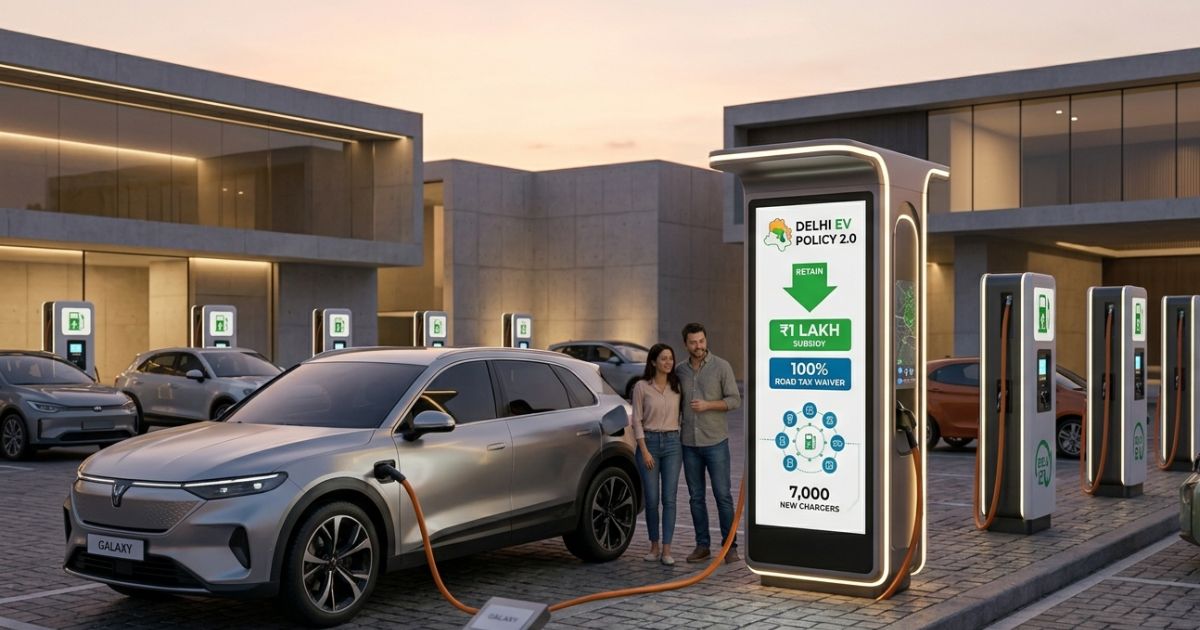
The Delhi Government has officially hit the “accelerate” button on clean mobility. On March 21, 2026, new details regarding the Delhi Electric Vehicle Policy 2.0 have emerged, focusing on making EVs more affordable than ever and eliminating “range anxiety” with a massive infrastructure blitz.
With the current policy expiring this month, the 2.0 version introduces aggressive subsidies, a unique retrofitting incentive, and a quarterly roadmap for charging stations.
1. Massive Subsidies & Financial Benefits
The new policy aims to put 1 lakh electric cars and over 5 lakh electric two-wheelers on the road by providing direct financial support via Direct Benefit Transfer (DBT).
- Electric Cars: A subsidy of ₹10,000 per kWh (capped at ₹1 Lakh per vehicle) for the first 1 lakh applicants purchasing an EV priced under ₹15 Lakh.
- Electric Two-Wheelers: A standard subsidy of ₹5,000 per kWh (up to ₹30,000), with a special incentive of up to ₹40,000 for those switching from old petrol models.
- Tax Exemptions: 100% waiver on Road Tax and Registration Fees for all EVs priced up to ₹30 Lakh until March 31, 2030.
Read More : India’s “Space Junk” Status: ISRO Ranks 12th Globally in Debris, Targets Debris-Free Space by 2030
2. Infrastructure: 7,000 Chargers in 2026
To bridge the gap in charging availability, the government has set strict quarterly targets to install 7,000 new charging points this year alone.
| Quarter | Targeted Charging Points | Focus Area |
| Q1 (Jan-Mar) | 1,000 | Metro Stations & RRTS |
| Q2 (Apr-Jun) | 1,500 | Malls & Market Complexes |
| Q3 (Jul-Sep) | 2,300 | Residential Societies |
| Q4 (Oct-Dec) | 2,200 | Government Buildings & Parks |
Additionally, a Fast-Charging Corridor is being developed along the Outer Ring Road, featuring high-speed chargers every 5 km.
3. The “Retrofitting” Revolution
In a first-of-its-kind move, Delhi is encouraging citizens to convert their existing petrol/diesel cars into EVs instead of scrapping them.
- The Incentive: A one-time grant of ₹50,000 for owners who retrofit their ICE vehicles with approved electric kits.
- Benefit: This allows owners of 10-year-old diesel or 15-year-old petrol cars (which would otherwise be banned) to continue driving them legally as EVs.
- Limit: This specific incentive is currently limited to the first 1,000 conversions to test the technical feasibility.
4. Battery Recycling & Circular Economy
As EV adoption grows, battery waste becomes a concern. Policy 2.0 introduces a dedicated Battery Recycling Framework.
- Nodal Agency: The Delhi Pollution Control Committee (DPCC) will oversee the safe disposal and material recovery of old batteries.
- Extended Producer Responsibility (EPR): Manufacturers (OEMs) will now be legally responsible for the “end-of-life” management of the batteries they sell.
- Swapping Stations: 100 new battery-swapping stations are being added to support e-auto rickshaws and delivery fleets.
Read More : India’s “Space Friend” Vyommitra Ready for Launch: ISRO’s Gaganyaan G1 Mission Update