
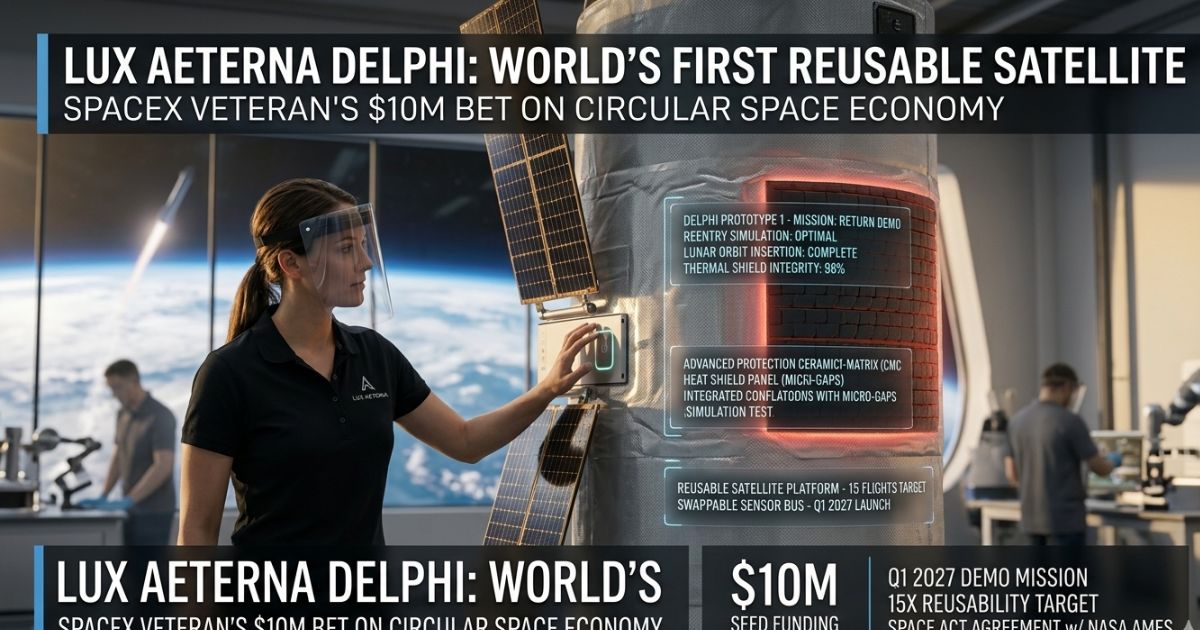
While reusable rockets have already slashed the cost of reaching orbit, the satellites themselves have remained “single-use” consumables—until now. Today, March 11, 2026, Denver-based startup Lux Aeterna, founded by former SpaceX engineer Brian Taylor, announced it has secured $10 million in an oversubscribed seed funding round to fix space’s biggest waste problem.
The mission is simple: Why throw away a billion-dollar satellite after its mission when you can bring it back, tune it up, and relaunch it?
1. Delphi: The First Returnable Satellite Platform
Lux Aeterna is developing its flagship spacecraft, Delphi. Unlike traditional satellites that burn up in the atmosphere at the end of their life, Delphi is engineered to survive the “violence” of atmospheric reentry.
The Breakthrough Tech:
- Conical Heat Shield: Borrowing principles from the Dragon capsule and Starship, Delphi uses a specialized heat shield to protect sensitive electronics during its 17,500 mph return journey.
- Modular “Bus” Architecture: The satellite is designed like a chassis. Once it lands, technicians can swap out old sensors, upgrade AI processors, or replace batteries before sending it back up.
- Retractable Solar Arrays: To survive reentry, the satellite features unique solar panels that fold inward, protecting them from the extreme heat and pressure of the atmosphere.
Read More : Nothing Phone (4a) Series Launched: The “Pink” Revolution, Periscope Zoom, and a New Glyph Design
2. A “Circular Economy” for Space
Currently, thousands of dead satellites orbit Earth as “space junk,” posing a threat to future missions. Lux Aeterna aims to shift the industry toward a circular supply chain.
- The Goal: A single Delphi satellite is being engineered to be reused 15 times or operate for up to 15 cumulative years in orbit.
- Mission Flexibility: Because the hardware can be returned, companies can fly shorter missions (even just a few days) to test new tech, then bring it back for analysis rather than letting it drift for decades.
3. When is the First Launch? (Q1 2027)
The $10 million funding will accelerate the manufacturing of the first Delphi prototype.
- Fully Booked: Even though the first demonstration mission is slated for Q1 2027, Lux Aeterna has already sold out its entire payload capacity.
- Strategic Partnerships: The company has signed a Space Act Agreement with NASA Ames to refine its thermal protection systems, giving the startup massive technical credibility.
- High-Demand Use Cases: Beyond traditional communication, the company is targeting in-space manufacturing, hypersonic testing, and edge computing (on-orbit GPUs).
Final Thought
We’ve spent 70 years treating space hardware like a one-way trip. Lux Aeterna’s $10 million bet suggests that the future of orbit looks less like a graveyard and more like an airport. If satellites can start making the “round trip,” the cost of innovation in space is about to crash—in a good way.
Frequently Asked Questions (FAQs)
Q1: How does a satellite land?
While details on the final landing mechanism (parachutes vs. propulsive landing) are being refined, the current goal is a controlled splashdown or ground recovery similar to the Dragon capsule.
Q2: Won’t returning a satellite be more expensive than just building a new one?
In the short term, yes. However, Lux Aeterna argues that as hardware (like specialized GPUs and sensors) becomes more expensive and launch costs continue to drop, the ability to upgrade and reuse will offer massive long-term savings.
Q3: Is this related to SpaceX?
While not a SpaceX subsidiary, the founder is a veteran of the Starlink and Project Kuiper teams. The startup is applying the same “rapid iteration” culture that made SpaceX successful.
Q4: Can these satellites help reduce space junk?
Absolutely. By providing a reliable way to bring hardware back to Earth, Lux Aeterna ensures that dead satellites don’t remain in orbit as hazardous debris.
Q5: What is the weight of a Delphi satellite?
The prototype is roughly 200kg, with nearly 25-40% of that dedicated purely to payload capacity for customers.
Read More : The Legend Returns: Production-Spec Tata Sierra EV Debuts with 500km Range and Iconic Lounge Seating