
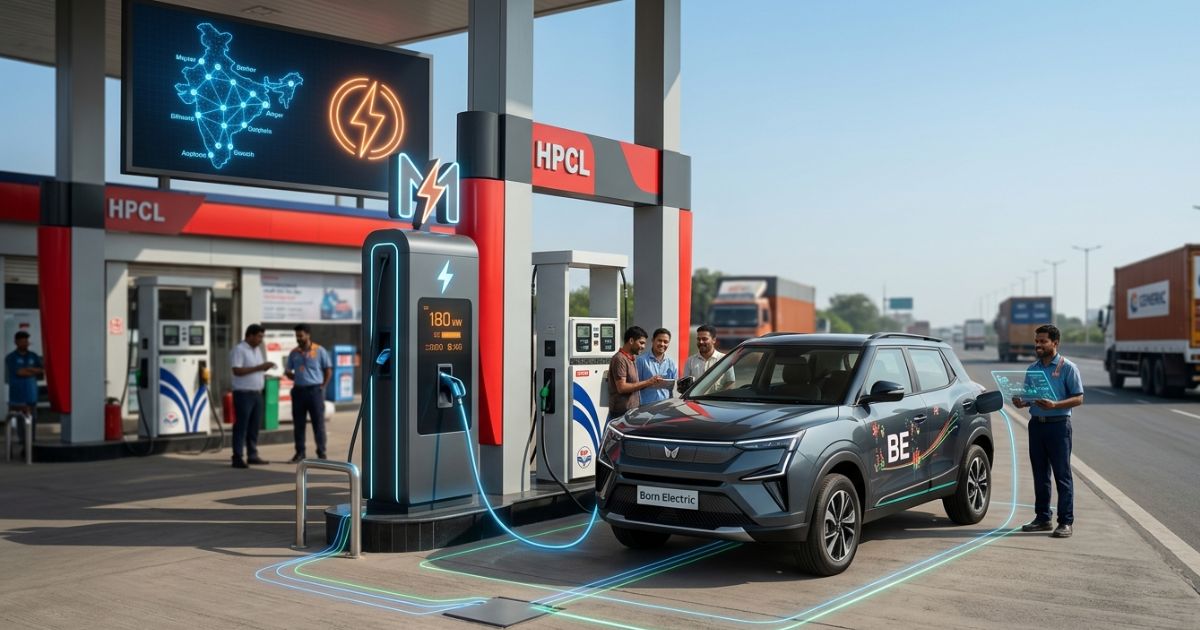
The biggest hurdle to electric vehicle (EV) adoption in India—Range Anxiety—just hit a massive roadblock. In a landmark strategic agreement announced on March 20, 2026, Mahindra’s dedicated charging arm, Charge_iN, has partnered with Hindustan Petroleum Corporation Limited (HPCL) to deploy ultra-fast charging infrastructure across HPCL’s massive nationwide network of 24,400+ retail outlets.
This partnership isn’t just about adding more plugs; it’s about high-speed capability. By installing 180 kW dual-gun DC fast chargers, Mahindra and HPCL are preparing India for a future of long-distance, seamless electric travel.
1. The Strategy: Leveraging a “Ready-Made” Network
Building a charging network from scratch is slow and expensive due to land acquisition and permits. Mahindra’s “Lean Engineering” approach sidesteps this by using existing infrastructure.
- The Scale: HPCL already operates over 24,400 fuel stations and 5,400 existing charging points under its ‘HP e-Charge’ brand.
- The Speed of Rollout: By utilizing established fuel bunks, Charge_iN can bypass the “Real Estate Trap,” allowing for a rapid nationwide expansion along critical highway corridors and dense urban centers.
Read More : India’s First Sovereign Agentic AI: NxtGen Launches ‘M’ Platform on NVIDIA Blackwell
2. Technical Edge: Why 180 kW is a Game Changer
Most public chargers currently found on Indian highways range between 30 kW and 60 kW. Mahindra’s decision to go exclusively with 180 kW hardware is a leap forward.
- Ultra-Fast Charging: For modern electric SUVs (like the upcoming Mahindra ‘Born Electric’ range), these chargers can add 200-300 km of range in under 20-30 minutes.
- Dual-Gun Setup: Each station can charge two vehicles simultaneously, reducing waiting times and doubling the station’s efficiency during peak travel hours.
3. Preparing for the “Born Electric” (BE) Era
For Mahindra, this rollout is a calculated move ahead of its upcoming product onslaught.
- Seamless Ecosystem: While the chargers will be open to all electric four-wheelers, Mahindra owners (XUV400 and upcoming BE.05, BE.07) are expected to enjoy a more integrated “Plug-and-Charge” experience via the Charge_iN app.
- Highway Connectivity: The primary focus is on connecting major state and national highways, making inter-city EV travel as predictable as petrol/diesel travel.
4. Comparison: Current vs. New Charging Infrastructure
| Feature | Standard Public Charging (2024) | Mahindra-HPCL Network (2026) |
| Power Output | 30 kW – 60 kW | 180 kW (Ultra-Fast) |
| Charger Type | Single Gun (Mostly) | Dual-Gun (Simultaneous) |
| Location | Standalone / Private Malls | Existing Fuel Stations (HPCL) |
| Primary Focus | Urban Commute | Inter-city / Highway Travel |
Frequently Asked Questions (FAQs)
Q1: Can non-Mahindra EV owners use these chargers?
Yes. The 180 kW chargers are designed for all electric four-wheelers using the standard CCS2 charging port, which is common across almost all EVs sold in India.
Q2: How much will it cost to charge?
While official rates are yet to be announced, the pricing is expected to be competitive with other public DC fast-charging networks, with potential “loyalty benefits” for Mahindra EV owners.
Q3: When will the 24,400 chargers be ready?
The rollout has already begun as of March 2026. Given that the locations are already active fuel stations, the deployment is expected to scale significantly faster than traditional charging networks over the next 12–18 months.
Read More : Huge Relief for Telangana Vehicle Owners: 2% Additional Tax Scrapped as State Joins Telangana ‘Vahan’ Portal