
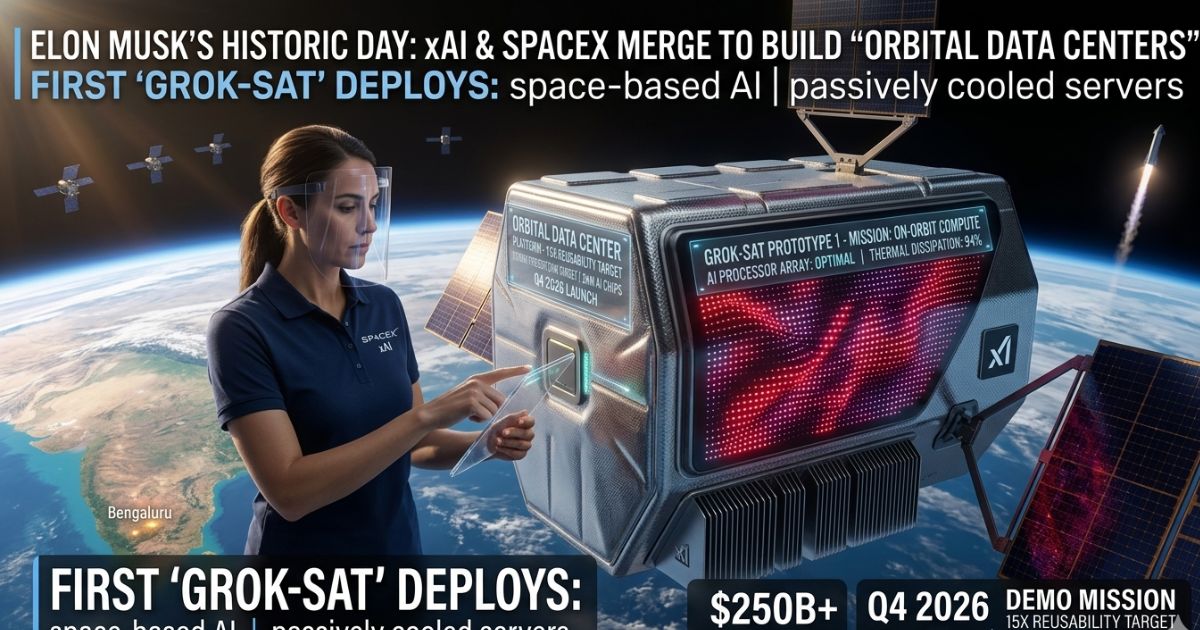
In a move that has redefined the boundaries of both the space and artificial intelligence industries, Elon Musk has officially announced the merger of SpaceX and his AI venture, xAI. This historical consolidation creating “SpaceX-xAI” (working title) marks the birth of a vertically integrated technological superpower aimed at conquering the final frontier of data processing: Space-Based AI.
The announcement, made early on March 13, 2026, from the Starbase facility in Texas, confirms rumors that have circulated for months. The new entity will leverage SpaceX’s unrivaled launch capability and Starlink infrastructure to deploy the world’s first network of dedicated Orbital Data Centers.
1. The Vision: Why Compute in Orbit?
The current limitations of AI development are ground-based: massive power consumption and cooling requirements. By moving AI processing into orbit, the new venture aims to solve both.
The Breakthrough Tech:
- Unlimited Solar Power: Satellites can access nearly continuous, high-intensity solar energy, bypassing the terrestrial grid’s limitations and carbon footprint.
- Passive Cooling: The vacuum of space provides a natural, passive cooling environment for massive server racks, eliminating the need for complex, water-intensive cooling systems used on Earth.
- On-Orbit Processing: Instead of beaming raw data down for processing (which causes latency), the Orbital Data Centers will process data on the satellite and send only the high-value insights down, revolutionizing sectors like Earth observation, climate modeling, and real-time navigation.
Read More : SpaceX Veteran’s New Startup: Lux Aeterna Secures $10M to Build “Reusable” Satellites
2. Synergies: How xAI and SpaceX Power Each Other
This merger is not just financial; it is a deep technological integration.
- xAI on Starlink: xAI’s advanced large language model, Grok, and its specialized vision models will be natively integrated into the Starlink user terminal. This means users will get direct-to-mobile, ultra-low-latency AI assistance without needing a separate ground-based cloud connection.
- AI-Optimized Rockets: SpaceX will use xAI’s real-time, high-fidelity physics simulations to optimize Starship launches and landing sequences, significantly reducing fuel consumption and increasing payload capacity for lunar and Martian missions.
- The “Grok-SAT” Platform: The new venture is already developing “Grok-SAT“—a dedicated satellite bus designed specifically to house thousands of specialized AI accelerator chips, designed in-house by xAI engineers.
3. Immediate Impact and Timeline (Q4 2026 Demonstration)
The market reaction has been explosive, with competing space and tech firms scrambling to adjust their strategies.
- $50 Billion Valuation Boost: Analysts predict the combined entity’s valuation could soar past $250 Billion within the next 12 months, driven by the unique synergy and immediate market demand.
- First Launch: The first “Grok-SAT” demonstration payload is scheduled to launch on a Falcon 9 in Q4 2026, with a full “Orbital Compute Constellation” planned for deployment via Starship starting in 2027.
- Global Security Focus: The immediate application for ultra-secure, tamper-proof, off-planet data storage and processing has already drawn intense interest (and scrutiny) from global defense departments.
Final Thought
We’ve spent decades using space to move data around Earth. Musk’s SpaceX-xAI merger flips the script: We will now use space to think about Earth. The era of the “Orbital Data Center” is here, and it suggests that the cloud is no longer just on our planet—it is the planet.
Frequently Asked Questions (FAQs)
Q1: Will Grok AI become free for Starlink users?
Currently, a basic version of Grok will be included with Starlink’s “Premium” and “Mobility” tiers. The advanced, real-time “On-Orbit Processing” tier will likely be a paid add-on.
Q2: Is this just about speed?
No. While it reduces latency, the primary driver is energy sustainability and security. An orbital data center is physically isolated and can operate with near-zero carbon emissions once deployed.
Q3: Can these satellites process data from other satellites?
Yes. SpaceX-xAI aims to provide “On-Orbit Compute as a Service” (CaaS). Other satellite operators can subscribe to send raw sensor data to Grok-SAT for instant analysis and insight retrieval.
Q4: Will this merger face regulatory hurdles?
Almost certainly. National security concerns regarding off-planet data storage and the consolidation of critical launch and AI infrastructure will likely lead to extensive reviews by the FTC and international space agencies.
Q5: What happens to existing SpaceX contracts?
Existing contracts for NASA, commercial launches, and Starlink customers will continue unaffected. The AI integration represents an optional, high-value service layer.
Read More : Is The iPhone Dead? Apple “Vision Air” Lightweight Glasses Leak