
The dream of sustained human life on Mars and the Moon has just moved one step closer to reality. While we are back on Earth today, March 14, 2026, the scientific community is buzzing with the final data analysis from India’s historic Axiom-4 (Ax-4) mission.
During his stay aboard the International Space Station (ISS), ISRO’s Gaganyatri Group Captain Shubhanshu Shukla successfully completed a series of groundbreaking experiments that could change how we think about food, health, and survival in deep space.
1. “Space Sprouts”: The Moong and Methi Experiment
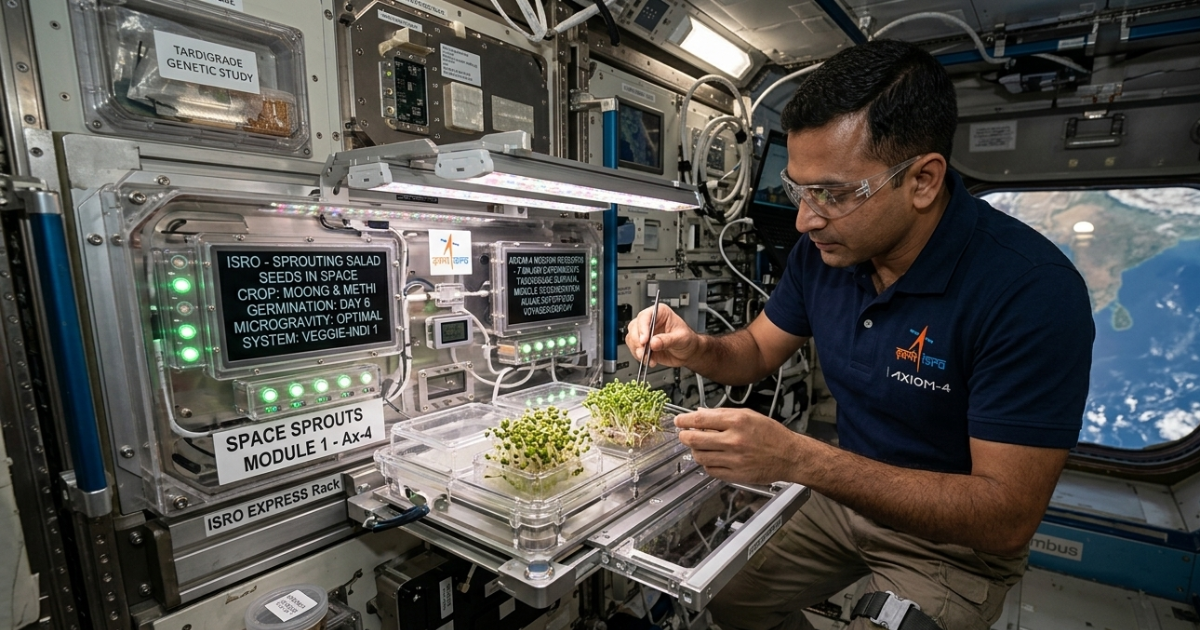
One of the most talked-about tasks was the “Sprouting Salad Seeds in Space” experiment. Conducted in collaboration with UAS (University of Agricultural Sciences) and IIT Dharwad, this wasn’t just about gardening—it was about survival.
- What was grown? Shubhanshu Shukla monitored the germination of Moong (Green Gram) and Methi (Fenugreek) seeds in microgravity.
- Why it matters: For long-term missions like Gaganyaan or a trip to Mars, astronauts cannot carry years’ worth of fresh food. Growing nutrient-dense “microgreens” like sprouts provides a sustainable source of Vitamin C and K.
- The Result: The experiment studied how gravity (or the lack of it) affects the direction of root growth and the nutritional density of the sprouts. These “space seeds” have been brought back to Earth for multi-generational testing.
Read More : Google Maps Gets Its Biggest Upgrade in a Decade: “Ask Maps” Powered by Gemini AI Rolls Out in India
2. Tardigrades: The “Immortal” Space Passengers
In a fascinatng biological study, Indian researchers from IISc Bengaluru sent a specific Indian strain of Tardigrades (also known as Water Bears) to the ISS.
- The Experiment: These microscopic creatures are famous for surviving the vacuum of space and extreme radiation. Shubhanshu studied their survival, reproduction, and transcriptomic (genetic) responses to the harsh ISS environment.
- The Goal: By understanding how Tardigrades protect their DNA in space, scientists hope to develop new ways to protect human astronauts from lethal cosmic radiation.
3. Beyond Food: Muscle Regeneration & Algae
The mission also focused on the physical toll space takes on the human body.
- Myogenesis (Muscle Repair): Using supplements developed by BRIC-InStem (Bengaluru), ISRO studied muscle regeneration in microgravity. This is critical because astronauts lose muscle mass rapidly in zero-G, similar to accelerated aging on Earth.
- Superfood Algae: Experiments on Spirulina (edible microalgae) explored its potential as a “Space Superfood.” Not only is it packed with protein, but it also consumes CO2 and produces Oxygen, making it a dual-purpose life support tool.
4. Key Highlights of the Axiom-4 Mission
| Feature | Details |
| Astronaut | Gp Capt Shubhanshu Shukla (Pilot) |
| Mission Duration | 18 Days in Orbit |
| Experiments Done | 7 Major Indian Research Modules |
| Launch Vehicle | SpaceX Falcon 9 (Dragon “Grace”) |
| Collaboration | ISRO, NASA, Axiom Space |
Final Thought
The success of the Axiom-4 mission proves that India is no longer just a “satellite launcher”—we are now a “space-faring laboratory.” From growing food in orbit to studying genetic resilience, the work done by Group Captain Shubhanshu Shukla has laid the foundation for India’s future permanent station in space.
Frequently Asked Questions (FAQs)
Q1: Why did ISRO choose Methi and Moong specifically?
These seeds are lightweight, require very little water to sprout, and are incredibly rich in proteins and antioxidants. They are the perfect “space crop” for short-term nutritional boosts.
Q2: Did the Indian astronaut eat the space-grown sprouts?
No. These specific samples were preserved and frozen to be brought back to labs in India for detailed genetic analysis to see if space radiation caused any mutations.
Q3: How does this mission help the Gaganyaan program?
The Axiom-4 mission served as a “technical rehearsal.” It helped ISRO understand how Indian hardware performs on the ISS and gave our astronauts vital experience in international docking and research protocols.
Q4: What is the “Voyager Display” experiment?
It was a study by IISc Bengaluru to see how astronauts interact with electronic screens in zero-G. It tracks eye movement and cognitive stress to design better cockpits for future Indian spacecraft.
Q5: Are Tardigrades dangerous if they escape in space?
Not at all. They are harmless, microscopic organisms that naturally exist on Earth. They are used in space research only because of their incredible toughness.
Read More : Elon Musk Marks Historical Day: xAI and SpaceX Officially Merge to Build “Orbital Data Centers”